
More than a year after the establishment of the new political system in Syria, the current government seeks to present itself as a model of tolerance, democracy, and openness to all segments of society. However, when compared to the social and on-the-ground reality, a widening gap emerges between official rhetoric and the lived experience of Syrians, particularly those who participated in the revolution and paid its price.
Selective support for shaping a political image
Today, the government pursues a policy of targeted support and reassurance for specific groups and communities, many of which were:
- Outside the revolution’s path
- Neutral during the uprising
- Previously affected by the fallen regime
This support is presented as evidence of pluralism and democracy, in an effort to build a positive image domestically and internationally. However, this approach comes at the expense of other communities, especially those that actively participated in the revolution and now find themselves excluded from decision-making and support.
The Revolution Without Representation
The clearest paradox is that all revolutionary components today are marginalized, politically, socially, and economically.
They have no genuine presence in state institutions, no real participation in policy-making, and no effective response to their fundamental demands, despite being the main force in overthrowing the previous regime.
This marginalization is not limited to a single group or region; it affects:
- Communities that embraced the revolution
- Areas devastated by war and displacement
- Millions of internally displaced persons and refugees
Camps: A Stark Example of Disconnection from Reality
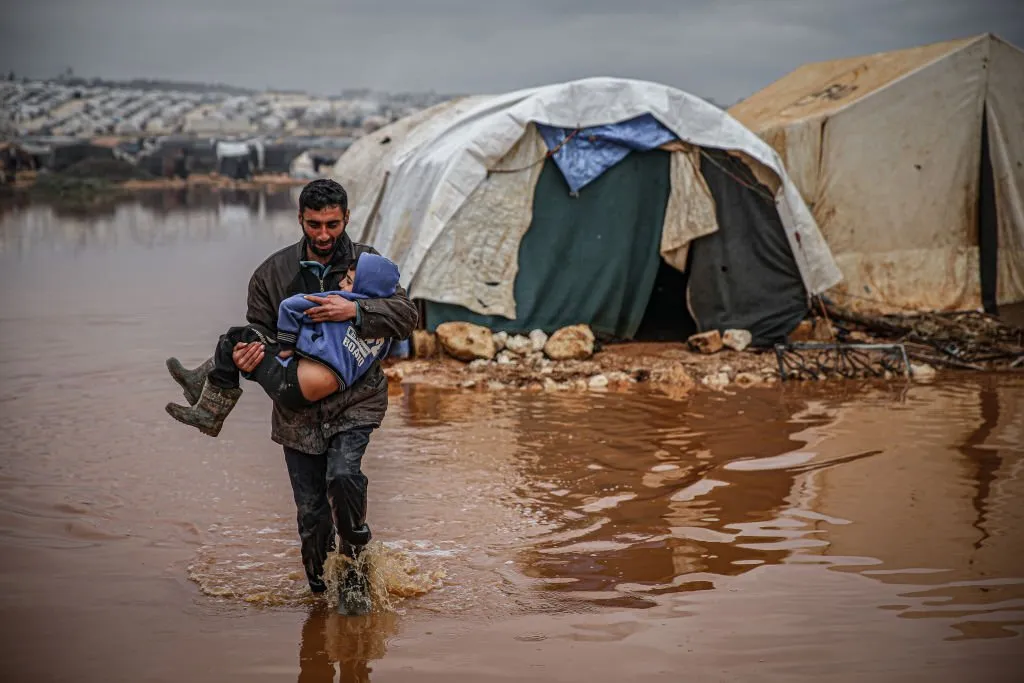
The conditions in northern Syrian camps exemplify this disconnection. With the first heavy rains, entire camps were flooded, affecting thousands of families already living in harsh humanitarian conditions, with no infrastructure or protection.
Despite the severity of the situation, government intervention remained largely limited to general statements, while families were left to face their fate—a repeat of old patterns of neglect, but under a new political facade.
Form, Not Substance: Democracy
Supporting select groups to display pluralism does not create real democracy.
Democracy is measured not by those who are politically accommodated, but by those who are genuinely treated with fairness.
When revolutionary forces are marginalized, and victims of the uprising are left without representation, protection, or a clear horizon, talk of justice and citizenship becomes mere rhetoric.
The Real Danger
The danger lies not in supporting a group or region, but in:
- Turning support into a propaganda tool
- Ignoring the social and humanitarian reality
- Excluding those who made sacrifices
Such an approach does not build a state; it creates new resentment, reproducing divisions in a subtler yet deeper manner.
Toward True Equity, Not Show
If the government is serious about building a democratic state, the path does not pass through selective favoritism. It requires:
- Genuine inclusion of all revolutionary components in decision-making
- Treating the camps and displaced as a humanitarian priority
- Aligning political rhetoric with the actual living conditions
- Ending the management of the state’s image at the expense of the people
Equity is not achieved through conferences or official statements—it is realized through bread, shelter, dignity, and justice.